Most people recognize Saudi Arabia as the birthplace of Islam. Every year, millions of Muslims go to the Saudi Kingdom to do Hajj and Umrah, the two sacred pilgrimages in Islam. However, religious significance is only one aspect of its history. Ancient civilizations, early trade routes, and heritage sites going back thousands of years can all be found throughout this country.
Today, the Saudi government is taking different initiatives to promote tourism in the country. Because of these initiatives, the number of travellers who want to visit the historical places in Saudi Arabia has increased in recent years. Moreover, travellers can find the roots of the Middle East to explore these Saudi historical sites. Muslim travelers are now encouraged to explore these historical gems across the Kingdom as part of their Umrah Travel 2026.
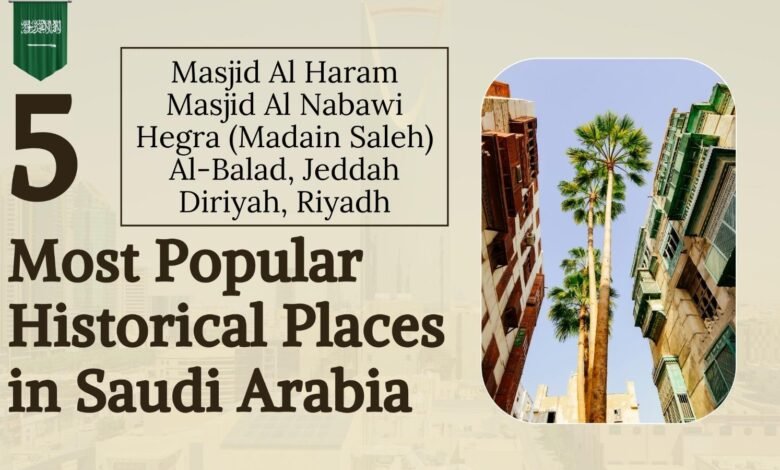
Below, we will talk about the five most popular Saudi heritage sites that continue to attract visitors from all over the world.
Masjid Al Haram, Makkah
Masjid Al Haram is located in the holy city of Makkah. It is the most sacred mosque in Islam. The mosque is home to the Kaaba, which was built by the Prophet Ibrahim and his son Prophet Ismail. To deal with the increasing number of worshippers, many Islamic rulers have expanded the mosque multiple times over the centuries.
Also, Masjid Al Haram has great importance for Muslims around the world because it is the primary location of performing Hajj and Umrah. When Muslims across the globe offer their five prayers daily, they face the Kaaba, which is situated at the center of this beautiful mosque. Apart from the Kaaba, this majestic mosque is home to different religious sites, such as Safa and Marwa, the Station of Abraham, and the Zamzam Well. Millions of Muslims visit the Grand Mosque of Mecca each year to carry out Hajj and Umrah, the two holy pilgrimages in Islam.
Why is it popular among tourists
Because of its great religious importance, Masjid al-Haram is one of Saudi Arabia’s most popular tourist destinations despite being inaccessible to non-Muslims. Visiting this historical landmark is a unique experience for every Muslim traveller that combines worship, history, and community.
An Important Tip to Consider
During different Islamic events like Hajj and Ramadan, millions of Muslims visit the Grand Mosque. According to a report, around 1.6 million Muslims performed Hajj in 2025. On the other hand, over 4 million believers done Umrah in Ramadan 2025, which is three times more than in other months of the year. So, Masjid Al Haram is crowded during these Islamic important occasions.
Due to this, the situation is difficult for many tourists, such as elderly, children, etc. For these travellers, going to Mecca during the months when the Grand Mosque is less crowded is crucial.
Masjid Al Nabawi, Madinah
In 622 CE, the Prophet Muhammad (PBUH) built Masjid Al Nabawi in the holy city of Madinah. The original structure was a simple outdoor building constructed from mudbrick and palm trunks. It has been expanded and renovated over centuries by several caliphs and kings, which changing into the stunning architectural complex that can host more than a million worshippers.
The tomb of Prophet Muhammad (PBUH) is located in Masjid Al Nabawi. Because of this fact, the Prophet’s Mosque is the second-holiest site in Islam. It is also the site of numerous important Islamic events and the formation of the early Muslim community. The Prophet’s Mosque is a symbol of Islamic unity, peace, and guidance.
Why is it popular among travellers
Pilgrims who go to Mecca for Hajj or Umrah frequently travel to Madinah to visit the Prophet’s Mosque. It is a very important location for both religious travelers and those interested in history because of its calm atmosphere, iconic green dome, and historical significance.
A Crucial Tip to Consider
Visiting the Prophet Muhammad’s tomb and offering two rakats of prayer at “Riyadh Al Jannah” is a beautiful dream for every Muslim around the world. However, you cannot fulfil this wonderful wish without issuing a ‘Rawdah’ permit from the Nusuk platform. To avoid this issue, you must get a Nusuk permit before going to the tomb of Prophet Muhammad (PBUH).
Hegra (Madain Saleh)
Hegra, which is situated in the center of the AlUla desert, is possibly the most famous Saudi historical site. It was the southern capital of the Nabataean Kingdom, the same civilization that constructed Jordan’s popular city of Petra. Also, it is the first UNESCO World Heritage site in the Kingdom.
Hegra was a major hub on the Incense Route, a huge network of trade routes that carried luxury goods, silk, and spices, and goes back to the first century BCE. More than 110 highly preserved graves are carved into the yellow sandstone outcrops at the location. In contrast to Petra, which was a hidden valley city, Hegra is spread out around a vast desert that makes the buildings even greater sense of beauty.
See also: Saudi Visa Guidance for Women Traveling From the United States
Why is it popular among tourists
The “Lonely Castle” (Qasr al-Farid), a massive four-story tomb carved out of a single isolated rock, attracts tourists with its mystery and beauty. There are some of the most amazing photography chances in the world because of the contrast between the elaborate facades and the natural, untouched desert environment.
An Important Tip for Travellers to Hegra
To maintain the site properly, having the access to Hegra is strictly controlled. To avoid this issue, it is important to book your “Hegra Experience” tour through the official AlUla website months in advance.
Al-Balad, Jeddah
Al-Balad is the center of the Red Sea, if AlUla is the spirit of the desert. Established in the seventh century, this old Jeddah neighborhood was the main entry point for pilgrims going to Makkah.
Al-Balad is famous for its unique Hijazi architectural style. The structures are built of coral stones taken from the Red Sea. They are decorated with rawasheen, which are elaborate, hand-carved wooden bay windows that allow in the sea breeze and give residents privacy.
Cultural Significance
Al-Balad was a cultural melting pot for more than a thousand years. A heritage of diverse cuisine, music, and customs was left behind by pilgrims traveling through from Africa, Asia, and Europe. King Abdulaziz, the founder of modern Saudi Arabia, previously lived in the magnificent 19th-century residence known as the Nassif House.
A Guideline for Tourists to Al-Balad
To explain the different families’ history who built the coral towers in Al-Balad, it is important to hire a local guide.
Diriyah, Riyadh
The capital of the first Saudi state, founded in 1727, Diriyah is situated on the outskirts of Riyadh. It is also the ancestral residence of the House of Saud.
With its large mud-brick palaces and administrative structures, the At-Turaif area in Diriyah is a UNESCO World Heritage site. Constructed in the Najdi architectural style, it was formerly a powerful political and religious hub that dominated the Nejd plateau’s trade routes.
Cultural Significance
Diriyah is a symbol of the Saudi people’s resilience and heritage. It served as the main point of an effort to bring the Arabian Peninsula together. It now serves as a symbol of national identity and is becoming a prominent cultural center due to its ongoing restoration efforts.
A Crucial Tip for Travellers to Diriyah
When you visit this historical landmark between November and March, you can experience the “Diriyah Season” festivals. There are different concerts and sporting events in these festivals. So, in this case, think about this thing.
Today it is very easy for you to plan an entire trip to explore the “5 most famous historical sites in Saudi Arabia” by using the official Saudi tourist website or approved travel agencies such as Labbaik Hajj Umrah.
To Sum Up
Saudi Arabia is the birthplace of Islam. It is home to Masjid Al Haram and Masjid Al Nabawi, the two sacred sites in Islam. Apart from its religious tourism, the Saudi Kingdom has a variety of historical sites, such as Hegra (Madain Saleh), Diriyah, and Al-Balad. By visiting these sites, you can explore the Middle East’s roots.